22 September 2026 · Chiropractic
Shoulder labrum tears: SLAP, Bankart, and what they mean
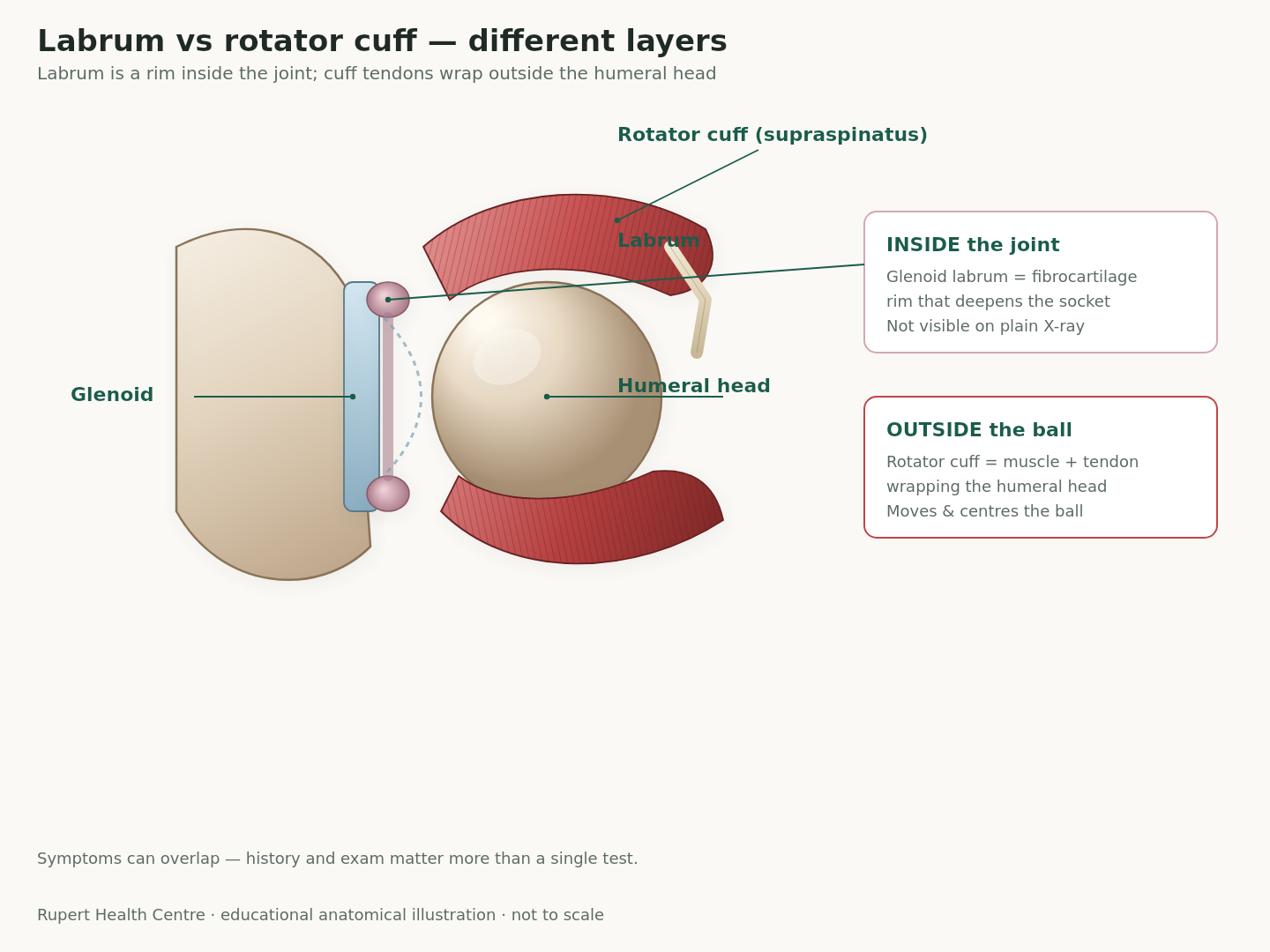
A deep click in the shoulder after a fall, a sense that the ball might “slip,” or stubborn pain with overhead work can raise the question of a labrum tear. The labrum is not the rotator cuff — it is a different layer of tissue inside the joint — and the words SLAP and Bankart describe where that rim is injured, not a single one-size-fits-all diagnosis. This companion article to our overview of rotator cuff injuries, sprains and calcific tendinitis explains the anatomy in plain language, common injury patterns, how symptoms often differ from cuff problems, and how imaging, rehab and specialist referral usually fit together.
General education only. It is not a diagnosis or a personal treatment plan. Sudden deformity, a shoulder that will not stay in place after trauma, inability to lift the arm, fever with a hot swollen joint, or progressive neurological loss needs urgent medical care.
What the glenoid labrum is
The shoulder is a shallow ball-and-socket. The ball is the head of the humerus (upper arm bone). The socket is the glenoid — a small, pear-shaped surface on the scapula (shoulder blade). Because the socket is shallow, the joint relies on soft tissues for stability: the joint capsule, ligaments, the rotator cuff muscles that keep the ball centred, and a rim of strong fibrocartilage called the glenoid labrum.
American Academy of Orthopaedic Surgeons (AAOS) OrthoInfo describes the labrum as a fibrous tissue rim that surrounds the glenoid, deepens the socket (by up to about half again in some descriptions), and serves as an attachment site for ligaments and for one of the biceps tendons. Think of it as a bumper or gasket around the edge of a shallow dish — not a muscle you can “flex,” but a structural rim that helps the ball stay seated during reach, throw and load.
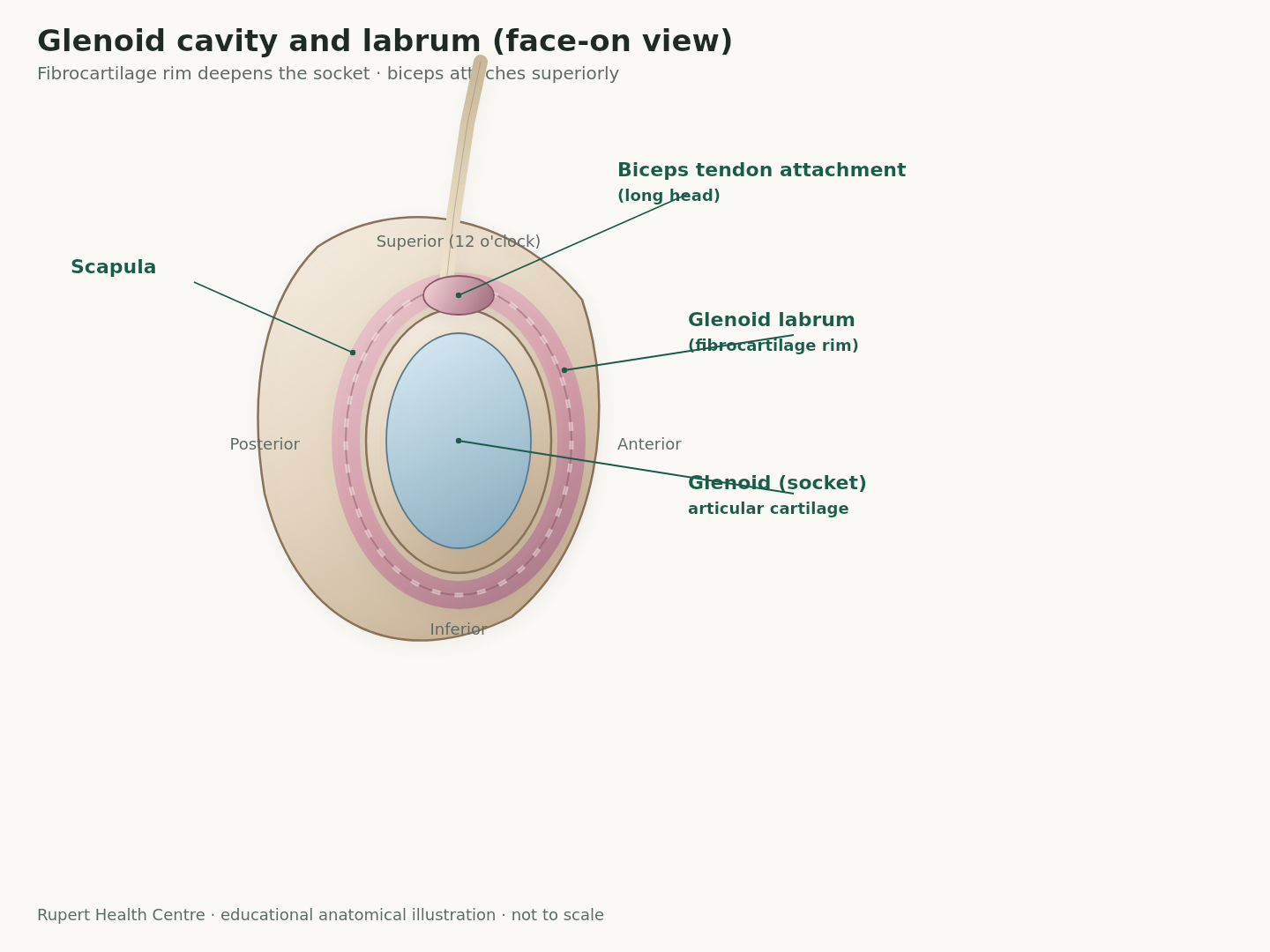
Two practical points follow from this anatomy. First, labral tissue does not show on a plain X-ray the way bone does — so “normal X-rays” do not rule a labrum problem in or out. Second, age-related fraying of the superior labrum can appear on MRI in people over roughly 30–40 without being the main pain generator; OrthoInfo notes that wearing down of the superior labrum can be part of normal aging and differs from an acute tear in a younger athlete. Imaging answers a clinical question; it does not automatically dictate surgery.
Types of labral injuries (explained calmly)
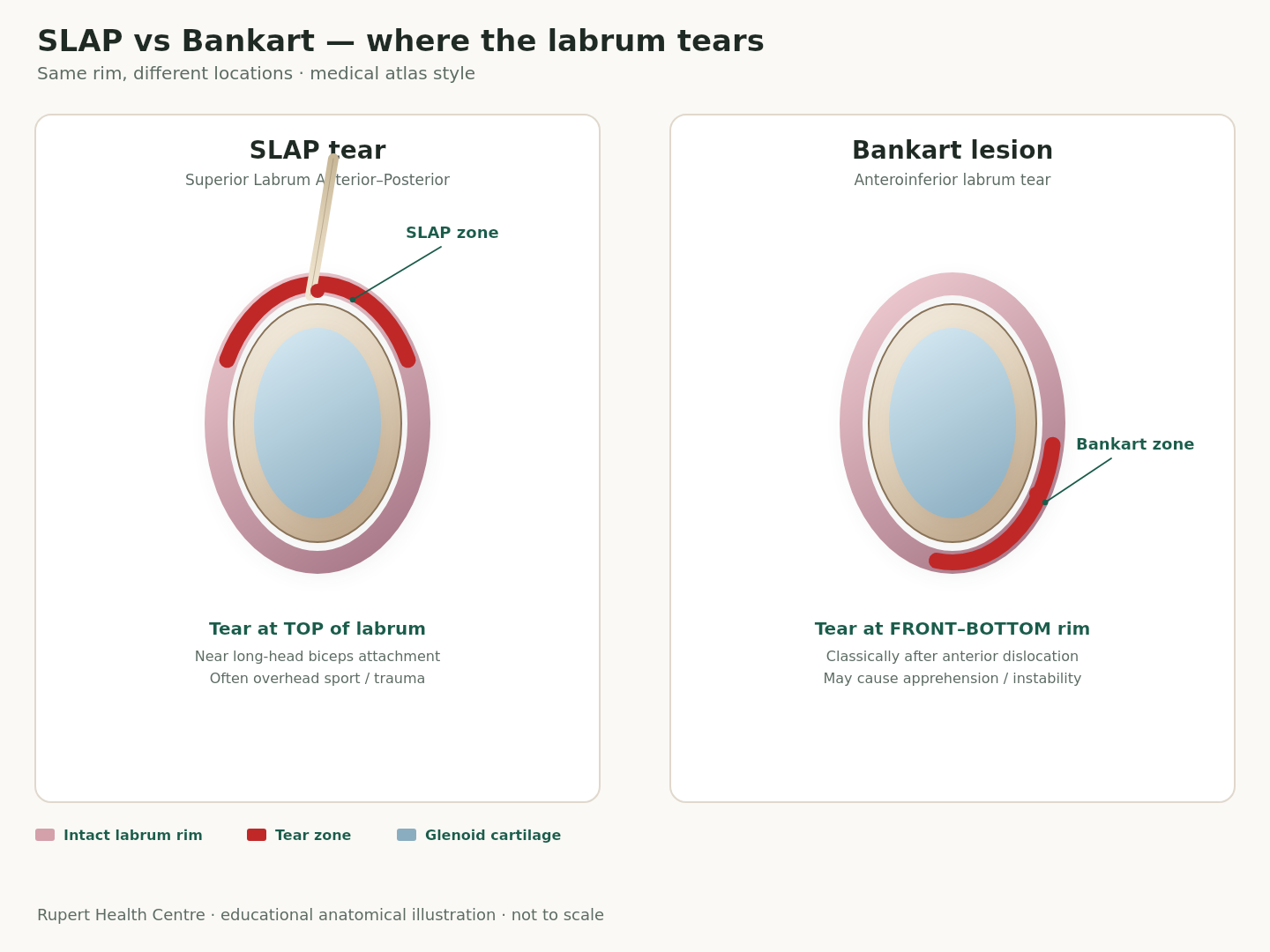
Clinicians name labral injuries by location around the socket. The three patterns patients hear about most often are SLAP tears, Bankart lesions, and posterior labral tears. Other named variants exist in surgical literature; for most people, understanding the big map is enough.
SLAP tears
SLAP stands for Superior Labrum Anterior and Posterior. OrthoInfo explains that the injury involves the top (superior) part of the labrum — the same region where the long head of the biceps tendon attaches — and that the tear can extend from the front toward the back of that attachment. The biceps tendon itself may or may not be involved.
Causes sit on a spectrum:
- Acute trauma — fall onto an outstretched arm, forceful pull on the arm, motor vehicle collision, rapid overhead load, or dislocation (per OrthoInfo).
- Repetitive overhead sport or work — throwing athletes, weightlifters and similar overhead patterns can load the superior labrum and biceps anchor repeatedly.
- Degenerative fraying — slower wear with age; a scan finding alone is not the same as a symptomatic tear.
Common symptoms OrthoInfo lists overlap with other shoulder problems: locking, popping, catching or grinding; pain with certain positions or overhead lifting; reduced strength or motion; a feeling the shoulder might “pop out”; and in pitchers, loss of velocity or a “dead arm” sensation after throwing.
Bankart lesions
A Bankart lesion is a tear of the labrum at the front-bottom (anteroinferior) part of the socket. OrthoInfo’s glenoid labrum overview and its chronic shoulder instability article link this pattern closely to anterior shoulder dislocation — when the ball comes out the front of the socket and damages the labrum and associated ligaments. Cleveland Clinic’s patient education on Bankart lesions similarly notes that many first-time dislocations involve this rim injury, and that recovery of the soft tissue may take longer than the reduction of the dislocation itself.
People with Bankart-related problems often describe apprehension with the arm in “throwing” positions (abduction and external rotation), a history of the shoulder coming partially or fully out, or a sense of instability more than isolated cuff-style night pain. Recurrent dislocations or repeated subluxations raise the chance that structural labral (and sometimes bony) damage needs an orthopaedic opinion — not because every case needs an operation tomorrow, but because recurrence risk and sport demands change the conversation.
Posterior labral tears and other patterns
The labrum can also tear at the back of the socket (posterior). OrthoInfo notes this may follow trauma or develop with wear. Posterior problems sometimes relate to contact sports, seizures or electric shock (posterior dislocation mechanisms), or chronic loading with the arm pushing forward. Surgical literature also describes more specific variants (for example ALPSA, GLAD, HAGL) that matter for operative planning; in clinic we usually start with the simpler map — superior vs front-bottom vs back — plus whether the joint feels stable.
StatPearls’ review of superior labrum lesions emphasises that tear “type,” patient age, sport goals and associated injuries heavily influence treatment choices. That is a useful reminder: two people with the same MRI label can reasonably follow different paths.
Signs and symptoms — and how they differ from rotator cuff issues
Labral and rotator cuff problems can coexist, and both can cause deep ache and overhead pain. Still, the story and exam clues often lean one way or the other. Our shoulder injuries overview covers cuff tendinopathy, sprain/strain and calcific tendinitis in more detail; the contrast below is a starting map, not a self-diagnosis tool.
Clues that often point more toward the labrum
- Mechanical sensations: catch, lock, pop or grind with specific arcs of motion.
- Deep joint pain with overhead sport, load across the body, or weight-bearing through the arm (push-ups, planks).
- A feeling of looseness, “slipping,” or fear the shoulder will come out — especially after a known dislocation or subluxation.
- Throwing athletes: dead-arm sensation or loss of control/velocity without clear isolated cuff weakness alone.
Clues that often point more toward the rotator cuff
- Dull lateral or deep ache worse at night or when lying on that side.
- Clear weakness lifting or rotating the arm away from the body (empty-can or resisted external rotation patterns).
- Pain after repetitive overhead work or age-related degenerative cuff change, without instability history — patterns summarised in Mayo Clinic and OrthoInfo rotator cuff guidance.
Exam room tests that stress the superior labrum or biceps anchor, and tests that provoke apprehension for instability, help clinicians decide next steps. Neck referral, AC joint pain and bursitis can mimic pieces of both pictures, which is why a structured assessment beats internet symptom checklists.
Imaging and specialist referral (educational, not alarming)
Most pathways start with history and physical examination. Useful imaging notes drawn from OrthoInfo and clinical reviews:
- X-rays — show bone (fracture, arthritis, some bony Bankart or Hill-Sachs changes after dislocation). They do not image the labrum itself.
- MRI — better for soft tissue; often the next step when symptoms persist or instability is suspected.
- MR arthrogram — MRI after contrast is injected into the joint; OrthoInfo notes this can help visualise SLAP tears more clearly when standard MRI is inconclusive.
Referral timing is about matching urgency to the story:
- Urgent / emergency pathways — first-time dislocation that will not reduce, suspected fracture, neurovascular change, or infection signs (see red flags below).
- Prompt orthopaedic or sports-medicine review — recurrent dislocations, clear instability in a young contact or overhead athlete, or significant traumatic tear with stalled function.
- Routine specialist discussion — persistent mechanical symptoms or sport limits after a fair trial of guided rehab (often measured in months, not days), when MRI findings and goals need a surgical opinion.
Family doctors, sports physicians and orthopaedic surgeons coordinate imaging and operative decisions. Chiropractic and massage clinics like ours contribute assessment, load management and rehab — and know when to hand the baton onward rather than “adjust through” true instability.
Conservative care, rehab, and when surgery is discussed
Nonsurgical care first for many SLAP-type presentations
OrthoInfo states that in most cases the initial treatment for a SLAP injury is nonsurgical: activity modification, medicines that are safe for the individual (often short courses of anti-inflammatories when appropriate), possible corticosteroid injection when diagnosis is unclear or inflammation dominates, and physical therapy focused on flexibility, capsule mobility and strengthening of the muscles that support the shoulder. Programs commonly run on the order of three to six months with a qualified therapist — progress is gradual by design.
Mayo Clinic Orthopedics and Sports Medicine similarly notes that many people with shoulder instability can be managed with physical therapy emphasising strength, scapular control and dynamic stability, while surgery enters the conversation for recurrent events, high recurrence risk, or associated injuries such as fractures or cuff tears.
What rehab usually emphasises
- Calm irritable positions early; avoid forcing painful end-range or repeated high-speed throws until control returns.
- Scapular endurance and rotator cuff strength so the ball centres better in the socket.
- Thoracic and rib mobility when stiffness feeds compensatory shoulder hiking.
- Gradual return to sport- or work-specific drills once day-to-day pain and apprehension settle.
At Rupert Health Centre (chiropractic and massage in East Vancouver), a labrum-concern visit looks a lot like other shoulder visits on the surface — mechanism, night pain, strength, instability screening, neck screen — but we are careful not to force glenohumeral end-range when apprehension or recent dislocation is part of the story. Manual care often targets the thoracic spine, ribs and soft tissue around the scapula while the rehab ladder does the heavy lifting for cuff and scapular control. Hands-on care is an adjunct to loading and time, not a substitute for orthopaedic decision-making when the joint is structurally unstable.
When surgery enters the conversation
Surgery is discussed, not assumed. OrthoInfo notes surgical consideration when pain does not improve with nonsurgical methods. Arthroscopy (small camera and instruments through tiny incisions) is the usual approach for many labral procedures. Depending on tear pattern, age and biceps involvement, surgeons may debride frayed tissue, repair labrum with anchors/sutures, or address the biceps (for example tenodesis or tenotomy) when the anchor is part of the pain generator. Bankart-type instability repair aims to reattach the labrum and tighten injured capsuloligamentous tissue so the ball is less likely to escape again.
Post-operative protection often includes a sling for weeks, then staged motion and strength — timelines vary by repair type; OrthoInfo cites sling use commonly in the 2–6 week range after SLAP surgery and a therapy progression measured in months, with throwing return often much later. Cleveland Clinic notes that full recovery after Bankart-related care can approach six months. Those numbers are educational averages, not promises.
Red flags — when to seek urgent care
- Shoulder that looks deformed or will not relocate after a fall, collision or seizure — emergency care.
- Numbness, coolness, colour change or marked weakness in the arm/hand after dislocation — urgent medical assessment.
- Sudden inability to lift the arm after trauma — same-day or urgent assessment (cuff tear and fracture remain on the list).
- Hot, red, swollen joint with fever or feeling systemically unwell — possible infection; seek medical care urgently.
- Progressive neurological loss, cord-type symptoms, unexplained weight loss or relentless night pain unrelated to position — prompt medical review.
Book a non-emergency clinic or family-doctor assessment sooner if catching/instability is limiting work or sport beyond a couple of weeks, strength is dropping, or you had a dislocation and the shoulder still feels unreliable.
Practical self-care tips
- Relative rest from the aggravating pattern. Shorten throwing sessions, avoid painful overhead presses and deep bench positions for a window; keep the elbow, wrist and hand moving.
- Do not force “stretch it loose” after instability. Aggressive end-range stretching into apprehension positions can be counterproductive; guided mobility is safer.
- Sleep position. Avoid lying directly on the sore side; support the arm with a pillow so the shoulder is neither hanging nor cranked behind the body.
- Ice or heat trials. Ice after aggravating activity helps some; heat before gentle mobility helps others. Use what settles symptoms.
- Scapular and cuff isometrics early. When a clinician clears you, light isometric external rotation and low-row scapular holds often beat endless pendulum swinging alone.
- Desk and carrying habits. Keep loads close to the body; avoid long reaches with heavy objects; micro-breaks matter if desk work hikes the shoulder (related: massage for desk-tight shoulders).
- Medicines. Over-the-counter options help some adults if safe for stomach, kidney and heart history — check with a pharmacist or family doctor.
- Respect dislocation history. If the shoulder has come out before, ask about bracing, sport timing and specialist input before returning to contact or overhead competition.
How this fits at Rupert Health Centre
We assess shoulders in the context of the neck, mid-back, and work or sport demands. For suspected labral irritation without frank instability, care plans emphasise education, graded loading and scapular/cuff capacity. When the history sounds like recurrent dislocation or high-grade traumatic instability, we help with early calm-down and referral pathways rather than promising that manipulation alone will “seat” a torn rim. Collision-related shoulder injuries can be billed through ICBC where appropriate; see our ICBC FAQ.
Related reading: Shoulder injuries: rotator cuff, sprains and calcific tendinitis · Frozen shoulder (adhesive capsulitis): stages, causes and what helps.
References
- American Academy of Orthopaedic Surgeons (OrthoInfo). SLAP Tears. https://www.orthoinfo.org/diseases--conditions/slap-tears/
- American Academy of Orthopaedic Surgeons (OrthoInfo). Shoulder Joint Tear (Glenoid Labrum Tear). https://www.orthoinfo.org/diseases--conditions/shoulder-joint-tear-glenoid-labrum-tear/
- American Academy of Orthopaedic Surgeons (OrthoInfo). Chronic Shoulder Instability. https://www.orthoinfo.org/diseases--conditions/chronic-shoulder-instability
- Mayo Clinic Orthopedics and Sports Medicine. Shoulder instability — Overview. https://sportsmedicine.mayoclinic.org/condition/shoulder-instability/
- Mayo Clinic. Rotator cuff injury — Symptoms and causes (for contrast with cuff presentations). https://www.mayoclinic.org/diseases-conditions/rotator-cuff-injury/symptoms-causes/syc-20350225
- Varacallo MA, et al. Superior Labrum Lesions. StatPearls. NCBI Bookshelf. https://www.ncbi.nlm.nih.gov/books/NBK557662/
- Cleveland Clinic. Bankart Lesion (Glenoid Labrum Tear). https://my.clevelandclinic.org/health/diseases/bankart-lesion-glenoid-labrum-tear
← Back to all posts · Book an assessment · 604.435.2285 · 2955 Kingsway