3 October 2026 · Chiropractic
Shockwave machines: crystal (piezoelectric) vs electromagnetic
Clinics advertise “shockwave” as if it were one machine. It isn’t. Focused shockwave devices make the wave in different ways. The two people ask about most often are the crystal type — piezoelectric — and the electromagnetic type. This article explains what those names mean, how a radial pressure-wave machine is a different device, and what reviews actually say about which generator is better.
This article is for education only and is not a diagnosis or a personal treatment plan. Shockwave is not the right next step for every sore tendon. Whether to use it, which machine, and what dose are clinical decisions.
What focused shockwave therapy is
Extracorporeal shock wave therapy (ESWT) means the wave is made outside the body and passed in through the skin. A shock wave is a very short acoustic pulse with a steep rise in pressure, lasting on the order of microseconds — not the same thing as the gentle wave of a diagnostic ultrasound scan. One review describes a shock-wave peak pressure as high as about 500 bar, versus about 0.5 bar for a typical ultrasound wave (Wang, 2012). In orthopedics the wave is not used to smash tissue the way kidney-stone treatment breaks a stone. It is used as a mechanical signal that may affect pain and tissue repair. The exact mechanism is still not fully settled (Wang, 2012; van der Worp et al., 2013).
Focused shockwave is built so the highest pressure lands at a chosen depth, in a small region called the focus, rather than on the skin (van der Worp et al., 2013). Reviews describe it as a non-surgical option that has been studied for stubborn tendon problems, including plantar fasciopathy (heel pain), Achilles and patellar tendinopathy, tennis elbow (lateral epicondylitis), and calcific and non-calcific shoulder tendinopathy (Wang, 2012; Schmitz et al., 2015). Results are not uniform. A review focused on patellar tendinopathy found conflicting trials, and listed the choice of generator as one of several settings that might matter but are hard to separate (van der Worp et al., 2013). A broader review of trials in the PEDro database was more positive about ESWT overall, and also reported no serious adverse events in the trials it included (Schmitz et al., 2015). Read that as “studied, and sometimes helpful,” not as a promise.
Radial pressure wave is a different machine
Many clinics use a radial device and still call it shockwave. International Society for Medical Shockwave Treatment (ISMST) guidelines describe that machine as ballistic: a projectile, sped up by compressed air or by a magnetic field, hits an applicator on the skin. Pressure is highest at the surface and falls as it spreads deeper. The guidelines say it is more accurate to call these pressure waves than shock waves, even though “radial shockwave” is the name patients hear (ISMST guidelines). A separate review makes the same physical point: the projectile is far too slow to create a true shock front, and the energy is more superficial than a focused wave aimed at depth (van der Worp et al., 2013). This article is not a radial-versus-focused comparison. It is worth knowing they are not the same box. On the question of which works better, a 2015 review found no scientific evidence favouring radial or focused ESWT for treatment outcome, and van der Worp and colleagues said they could not recommend one over the other from the studies they had (Schmitz et al., 2015; van der Worp et al., 2013).
Three ways to make a focused wave
Focused generators are usually grouped into three: electrohydraulic, electromagnetic, and piezoelectric (Wang, 2012; van der Worp et al., 2013; ISMST guidelines). All three make the wave in water inside the treatment head, because water and soft tissue transmit sound in a similar way, so less of the wave bounces back at the skin (van der Worp et al., 2013).
- Electrohydraulic — a spark gap in water. The spark itself is already a shock wave, then a reflector aims it. Mentioned here only so the list is complete. It is not the crystal-versus-coil question.
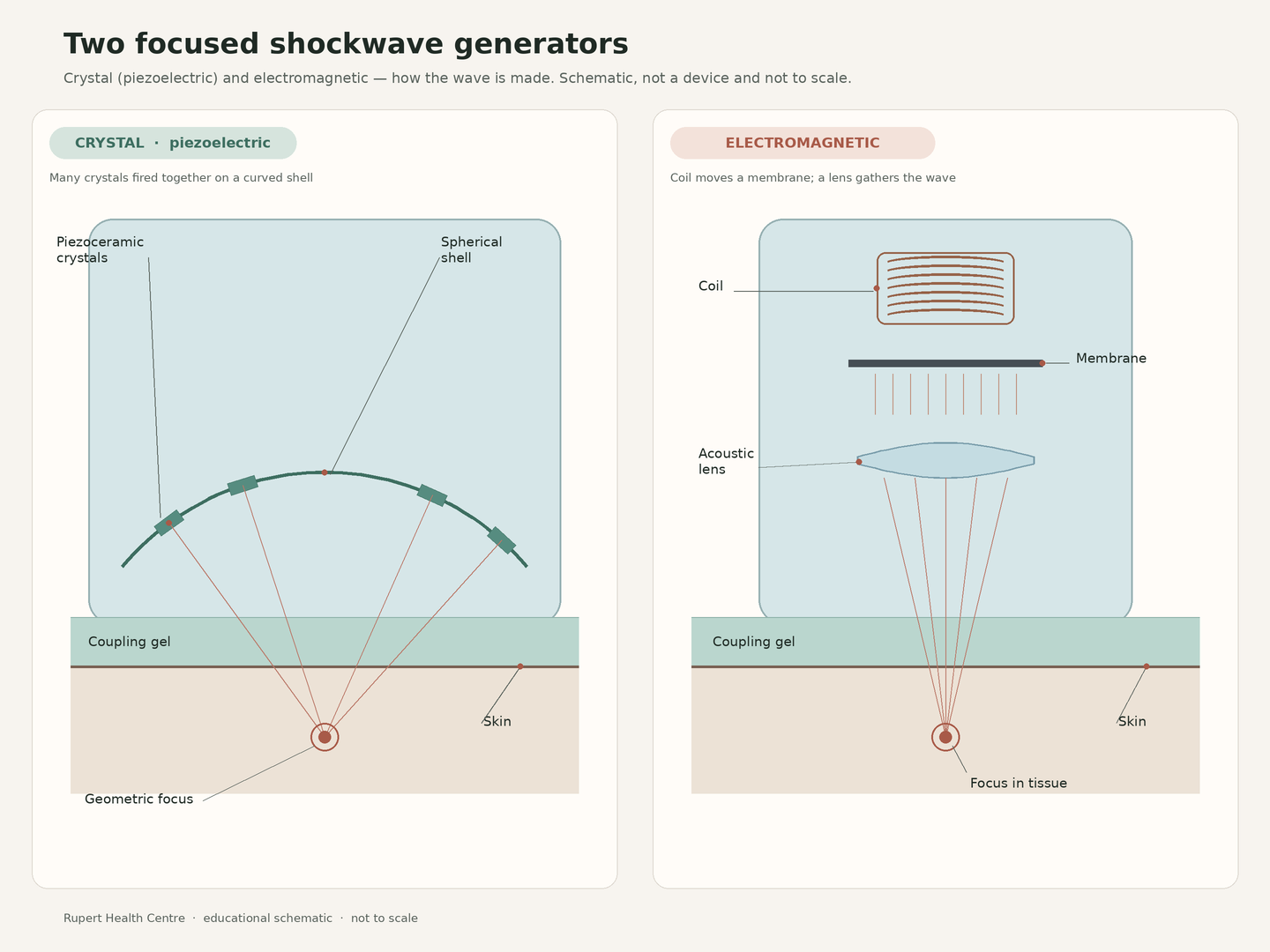
- Piezoelectric (crystal) — many small piezoceramic crystals.
- Electromagnetic — a coil and a membrane.
A useful difference: electrohydraulic waves are shock waves from the moment of the spark. Piezoelectric and electromagnetic waves start as pressure pulses and only steepen into a shock wave once they are focused (ISMST guidelines; van der Worp et al., 2013).
Crystal: piezoelectric
“Crystal” is the clinic nickname for a piezoelectric generator. A short high-voltage pulse makes each piezoceramic crystal change shape (the inverse piezo effect) and give off a pressure pulse. One crystal is not enough for the pressures used in treatment, so the head uses a large number of small crystals — often described as more than about 1,000, and in one schematic typically 1,000 to 2,000 — fired together by the same electrical discharge (Wang, 2012; Schmitz et al., 2015). They sit on a bowl-shaped, spherical shell. Because each crystal is aimed at the same geometric centre, the pulses add up at that point. That is self-focusing: no separate lens is required, though some designs also use a lens (ISMST guidelines; Wang, 2012; Schmitz et al., 2015). Wang describes the result as very precise focusing, with high energy inside a defined focal volume.
Electromagnetic
In an electromagnetic generator, a brief high-voltage pulse through a coil produces a fast-changing magnetic field. That field shoves an adjacent membrane, a bit like a loudspeaker cone but much harder (ISMST guidelines). Schmitz and colleagues describe the same idea in more detail: current in the coil induces current in a metal membrane, and a neighbouring membrane in the surrounding liquid is thrown outward so quickly that it launches a pressure wave in the liquid (Schmitz et al., 2015). The membrane may be flat, which makes a roughly flat wave, or cylindrical (ISMST guidelines).
The wave then has to be focused. A flat, planar wave is usually focused with an acoustic lens. A cylindrical wave can be focused with a reflector. The same guidelines also note that an electrohydraulic field is typically focused with a reflector (ISMST guidelines; Wang, 2012). The focal spot sits at a depth set by that lens or reflector, not by a dial the patient controls. As the wave travels toward the focus, its front steepens and the pressure rises (Wang, 2012; ISMST guidelines).
Differences that matter in the room
Marketing often jumps from “different physics” to “better results.” The physics differences below are real. A winner between crystal and electromagnetic is not.
- Where the shock forms. In both piezoelectric and electromagnetic heads, the pulse becomes a shock wave in the focal zone, not at the source. An electrohydraulic spark is a shock wave immediately (ISMST guidelines; van der Worp et al., 2013).
- Size of the focal zone. The focal zone is the small volume where pressure is high enough to count. How tight it is depends on the shape of the original wave and on the aperture of that head — how much of a sphere around the focus is used to generate pressure. The person being treated cannot adjust that (ISMST guidelines). Piezoelectric designs are described as extremely precise because the crystals already point at one centre (Wang, 2012). Some focused machines are instead line-focused or only weakly focused, on purpose, to spread energy over a larger area, which lowers the energy at the hottest point (ISMST guidelines). So “crystal” does not automatically mean a smaller spot than every electromagnetic device. It depends which head is on the machine.
- The dose is more than the generator name. Reviews list energy flux density (energy per area, in mJ/mm²), the number of pulses, how fast they are delivered, how many sessions, and how the sore spot is found — by feel, ultrasound, or X-ray (van der Worp et al., 2013). Wang adds pressure distribution and total energy at the focus as the numbers that matter when devices are compared, not the generation principle alone (Wang, 2012).
- Gel. Air almost completely reflects a shock wave. ISMST guidelines say the contact between the treatment head and the skin — and any spacer or gel pad used to set the depth — should be covered with a thin layer of ultrasound gel, or something similar such as castor oil, so air pockets in skin creases or hair do not block the wave.
- What it can feel like. The same guidelines say treatment can be painful. The dose is usually set from the person’s own feedback, and the session can be stopped. They also say local anaesthetic is usually not needed, and cite trials in which numbing the area reduced the effect of treatment (ISMST guidelines; also discussed in Schmitz et al., 2015). Common short-term effects listed by ISMST include pain during or after treatment, skin redness, and bruising. Tendon irritation, and occasionally tendon rupture, has been reported; the guidelines note that reported ruptures had also followed repeated cortisone injections, so the cause is not clean-cut. This is a reason the dose is a clinical decision, not a reason to skip an assessment.
A pattern that shows up often in trials — not a personal prescription — is about three sessions a week apart, around 2,000 pulses each, at the highest energy the person can tolerate without local anaesthetic (Schmitz et al., 2015). Session length in minutes is not fixed by those papers, and ISMST says the number of pulses and visits follows the condition being treated. Do not shop for a clinic by a claimed number of minutes.
Is crystal better than electromagnetic?
No review we relied on shows a clear winner.
Schmitz and colleagues looked at focused-shockwave randomized trials listed in PEDro and sorted them by generator: electrohydraulic, electromagnetic, or piezoelectric. Positive and negative trials were spread across all three. The mix was not statistically different (they report P = 0.229). Their plain-language conclusion: there is no scientific evidence that one focused technology is superior to the others. The paper’s lead author reports paid consulting work for a company that makes a radial device; the finding itself is a count of which generators were used in positive and negative trials, not a test of two heads on the same patients. They also note an older claim, drawn from kidney-stone machines, that electrohydraulic was superior — and say the musculoskeletal trials they counted do not support that claim (Schmitz et al., 2015).
That is not the same as a head-to-head trial of two machines on the same patients, and it is not proof the technologies are equal. In that count, electromagnetic devices had been used in many more trials than piezoelectric ones (42 trials with a positive outcome and 13 with a negative outcome, versus 6 and 2 for piezoelectric). “No proven winner” means the published trial tally does not crown a generator. It does not mean every head feels the same or that a future direct comparison could not find a difference for a specific tendon.
van der Worp and colleagues make a related point from the other direction: when patellar-tendinopathy studies disagree, one candidate reason is the long list of settings, including whether the generator was electrohydraulic, electromagnetic, or piezoelectric. They did not find a basis to prefer one focused technology (van der Worp et al., 2013).
What to tell the person treating you
ISMST lists situations where shockwave is avoided, or used only with extra care. For both radial and lower-energy focused treatment, those include a malignant tumour in the treatment field, a fetus in the field, and a pacemaker or defibrillator in the field. Higher-energy focused treatment adds lung tissue in the field and a significant clotting disorder, among others. Air-filled organs are a particular concern because the wave reflects strongly off gas (ISMST guidelines). Mention pregnancy, a pacemaker, a known mass in the area, blood thinners or a bleeding disorder, and recent cortisone injections. That is context for a proper visit, not a checklist you can clear yourself.
Which head a clinic owns is a poor way to choose care. The useful questions are whether the problem is one shockwave has actually been studied for, what else has already been tried (load changes and exercise often come first for tendinopathy), and how the dose will be matched to what you can tolerate. Generator type is one detail inside that decision.
How this fits at Rupert Health Centre
Rupert Health Centre, at 2955 Kingsway in East Vancouver, lists shockwave therapy among its services for stubborn soft-tissue problems, including calcific rotator cuff pain, plantar fasciitis, Achilles tendinopathy, tennis elbow, and jumper’s knee. See the shockwave section on our services page. The clinic uses a radial pressure-wave machine, which is a different type from the two focused generators this article compares. Whether shockwave is appropriate at all is decided at a visit — not from a brand claim.
An older note, Shockwave therapy – accelerate healing process (February 2020), is still on the site as an archived post. It has not been updated. Use this article, not that archive, for how the machines differ.
Related reading: plantar fasciitis · Achilles tendinopathy · patellar tendonitis · shoulder injuries, including calcific tendinitis.
References
- International Society for Medical Shockwave Treatment (ISMST), with the German-speaking Society for Extracorporeal Shockwave Therapy (DIGEST). ESWT Guidelines, English version. PDF posted December 2023. https://shockwavetherapy.org/wp-content/uploads/2023/12/ISMST-Guidelines-for-ESWT-_-engl-20231204.pdf
- Schmitz C, Császár NBM, Milz S, et al. Efficacy and safety of extracorporeal shock wave therapy for orthopedic conditions: a systematic review on studies listed in the PEDro database. Br Med Bull. 2015;116:115–138. https://pmc.ncbi.nlm.nih.gov/articles/PMC4674007/
- van der Worp H, van den Akker-Scheek I, van Schie H, Zwerver J. ESWT for tendinopathy: technology and clinical implications. Knee Surg Sports Traumatol Arthrosc. 2013;21(6):1451–1458. https://pmc.ncbi.nlm.nih.gov/articles/PMC3657080/
- Wang CJ. Extracorporeal shockwave therapy in musculoskeletal disorders. J Orthop Surg Res. 2012;7:11. https://pmc.ncbi.nlm.nih.gov/articles/PMC3342893/
← Back to all posts · Book an assessment · 604.435.2285 · 2955 Kingsway